Most of us know the headline advice: move more, eat well, sleep properly. The difficulty is never the knowing — it is fitting those things into a day that was already full before you added them. So instead of a plan that demands a new life, here is one built on stacking small habits onto what you already do.
Start where your day already has a rhythm
Habits stick when they are attached to something that already happens without thinking. The morning coffee, the walk to the car, the moment you sit down after work — these are reliable anchors.
- After your morning drink: a short walk, even around the block, before you check your phone.
- While the kettle boils: a minute of stretching, or a brief set of stairs.
- Before the evening meal: a plate rule that saves you from deciding anything when you are hungry.
- At bedtime: a consistent wind-down that quietly protects your sleep.
These feel almost too easy. That is the point — an easy habit repeated for years outperforms an ambitious one abandoned in a fortnight.
Nobody develops heart disease from a single heavy meal or one missed workout. Equally, nobody protects their heart with one virtuous week. Consistency is the treatment.
Build your plate around colour and fibre
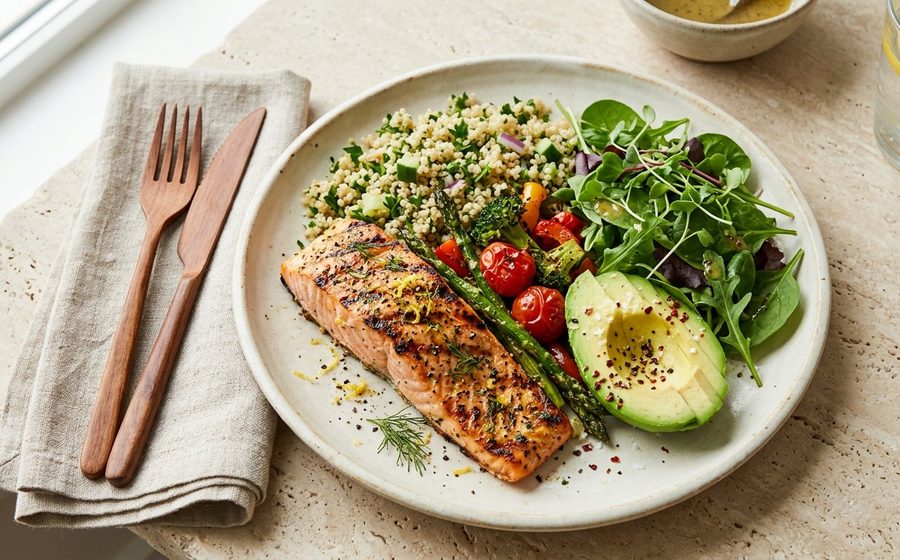
You do not need to count anything to eat well for your heart. Aim for vegetables or fruit at every meal, choose wholegrains over refined ones when the option exists, and let olive oil, nuts, seeds and fish appear regularly through the week.
- Fill roughly half the plate with vegetables and fruit.
- Keep a quarter for whole grains — oats, brown rice, wholemeal bread or pasta.
- Use the remaining quarter for protein: fish, beans, lentils, eggs, poultry or tofu.
- Watch liquid sugar. Sweetened drinks are one of the easiest places to reduce invisible load.
Move in ways you will actually repeat
For heart health, the best exercise is the one that survives a busy week. Moderate activity that leaves you slightly warm and slightly breathless is genuinely protective, and it counts whether it happens in a gym, on a footpath or in your living room.
- Aim to move on most days, even if a session is only a brisk ten minutes.
- Add two short strength sessions weekly — muscles help your metabolism and your blood sugar.
- Break up long sitting. Standing and moving briefly every hour is its own small win.
Protect your sleep like an appointment
Short or broken sleep raises blood pressure, increases appetite for sugary food and makes every other good habit harder to keep. Most adults do best with a consistent bedtime and a dark, cool, screen-light room. If snoring, gasping or persistent insomnia features in your nights, raise it with your clinician — these are treatable, not just annoying.
Know your own patterns, not just averages
Blood pressure and cholesterol are the two quiet numbers that most often decide long-term heart risk, and both can be improved before anything dramatic happens. A routine assessment gives you a baseline you can act on, and a reason to keep going.
Come and talk to us if you have a family history of early heart disease, if your blood pressure has crept up at previous checks, or if you simply want to know where you stand.
When to seek care sooner
Chest pain, breathlessness at rest, fainting or a sudden racing heartbeat are not wait-and-see symptoms. Seek urgent medical attention. For everything slower and subtler — fatigue, reduced stamina, swelling in the ankles — book a review, because the earlier we look, the more options we have.
The takeaway
Heart health is not a project you complete. It is a set of small, ordinary decisions that accumulate quietly in your favour. Pick one habit from this article, attach it to something you already do, and let it run for a month before you add another. Your heart responds to consistency long before it responds to intensity.